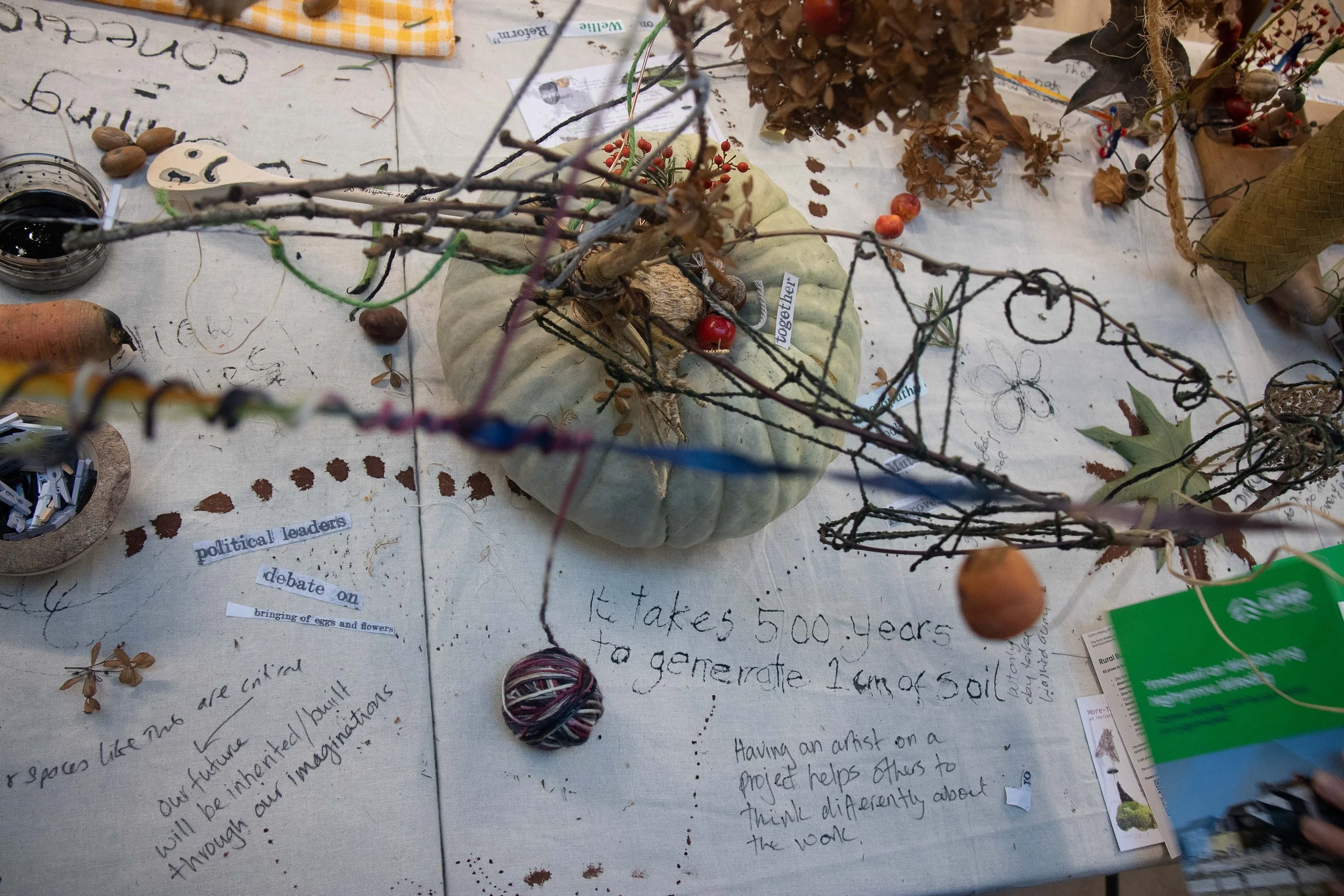
Reflections on “Come to the Kitchen Table” by Carreg Creative at the Wales Real food and Farming Conference, 2025
PART 2 : WORKING TOGETHER
Words by Siȃn Barlow, photos by Lindsey Colbourne
January 2026
“having an artist on a project
helps others to think differently
about the work”
In part one of this blog, “The Kitchen Table”, we gave an overview of the work of Carreg Creative in the arts strand of the 2025 Wales Real Food and Farming Conference. In this second part, we share some insights and patterns that are emerging from our work.
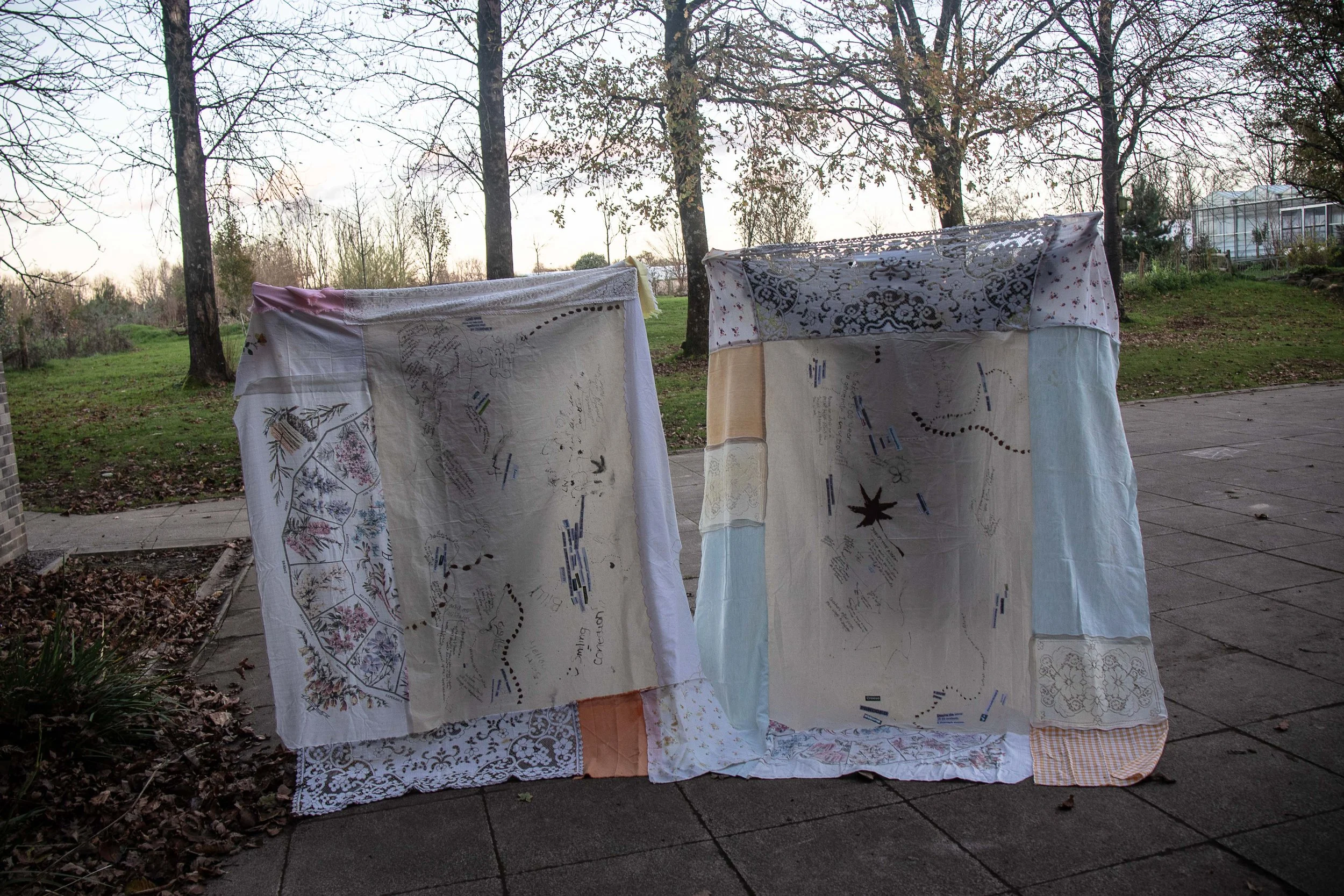
As part of the ongoing partnership between Carreg Creative and the Wales Real Food and Farming Conference, we have kept circling back to explore the wider question of "How might creative practitioners support and work with food and farming in Wales?” On the second day of the 2025 conference, we invited people working creatively at “The Kitchen Table” to consider the question. Thoughts and words started to appear on the tablecloth itself, and six strands or patterns seemed to be emerging: connection, beauty, transformation, imagination, diversity and celebration.
Creative work creates connection

“→ finding
common ground
← meeting in the
middle (ground) liminal space - space between
← gathering different
groups people together who wouldn't usually
meet one another in daily lives”
Not only was connection the theme that was explored in our creative work, but it also seemed to underpin what we did more generally, and to have been one of the functions of the conference arts strand.

“Come to the Kitchen Table” helped the conference to settle meaningfully into the remarkable place that is Pencoed College. Through inhabiting the college foyer over the course of the conference, making strange changes and filling it with visually interesting objects and activities, we acted as a bridge, connecting the conference with students and staff of the college. Connection with people and places involves drawing on the past, and through working with different objects, and with early 20th century newspaper cuttings of the Pencoed Mutual Improvement Society, connections were made in this direction too. As someone wrote on the tablecloth, creative practices can “→ bring history + heritage into space”.
Through our presence in the foyer, we were also able to support the flow of conference participants to and from sessions, as well as helping people to find what they needed in the intervals. Meanwhile, Carreg Creative’s Lisa Hudson was working within the space to create an interactive on-line map, assisting participants to connect across Wales by putting themselves and their own work in food and farming on the map.
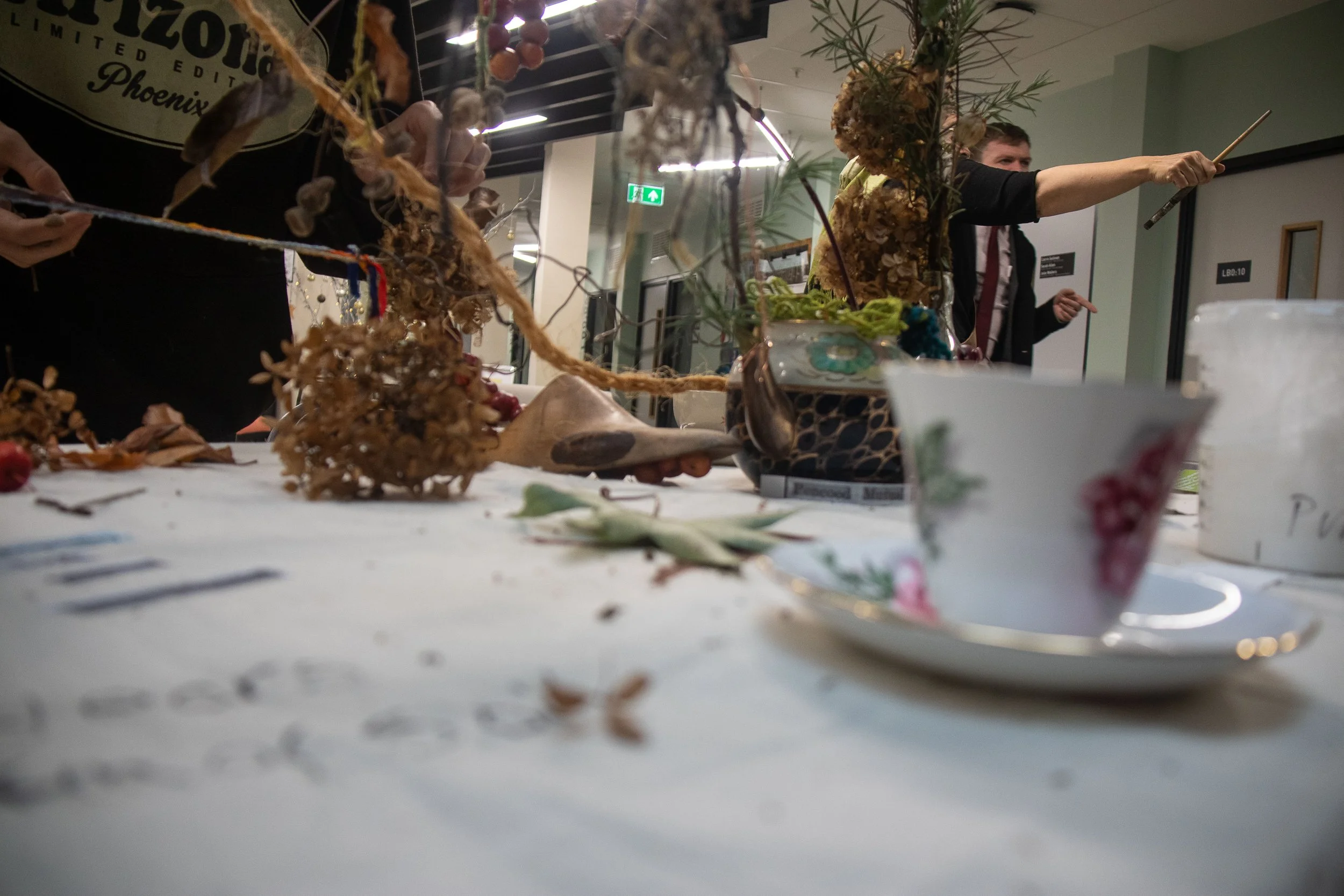
These “extras” seemed to enhance our work on the sculptural installation: building small relationships of trust as people were coming and going, making it more likely that they would find time to pause at “The Kitchen Table”, and more joyful when they did. On looking back and reflecting, we realised that we ourselves became an important connective element of the 2025 Wales Real Food and Farming Conference.
Creative work can help us to see beauty
The issues in food and farming are deeply felt and strongly contested. There is very real and very serious concern on all sides: about our environment, our communities, our culture, our futures. Taking time to talk about beauty may seem to be a distraction, drawing our attention away from where it could more usefully be placed. So why does beauty matter?
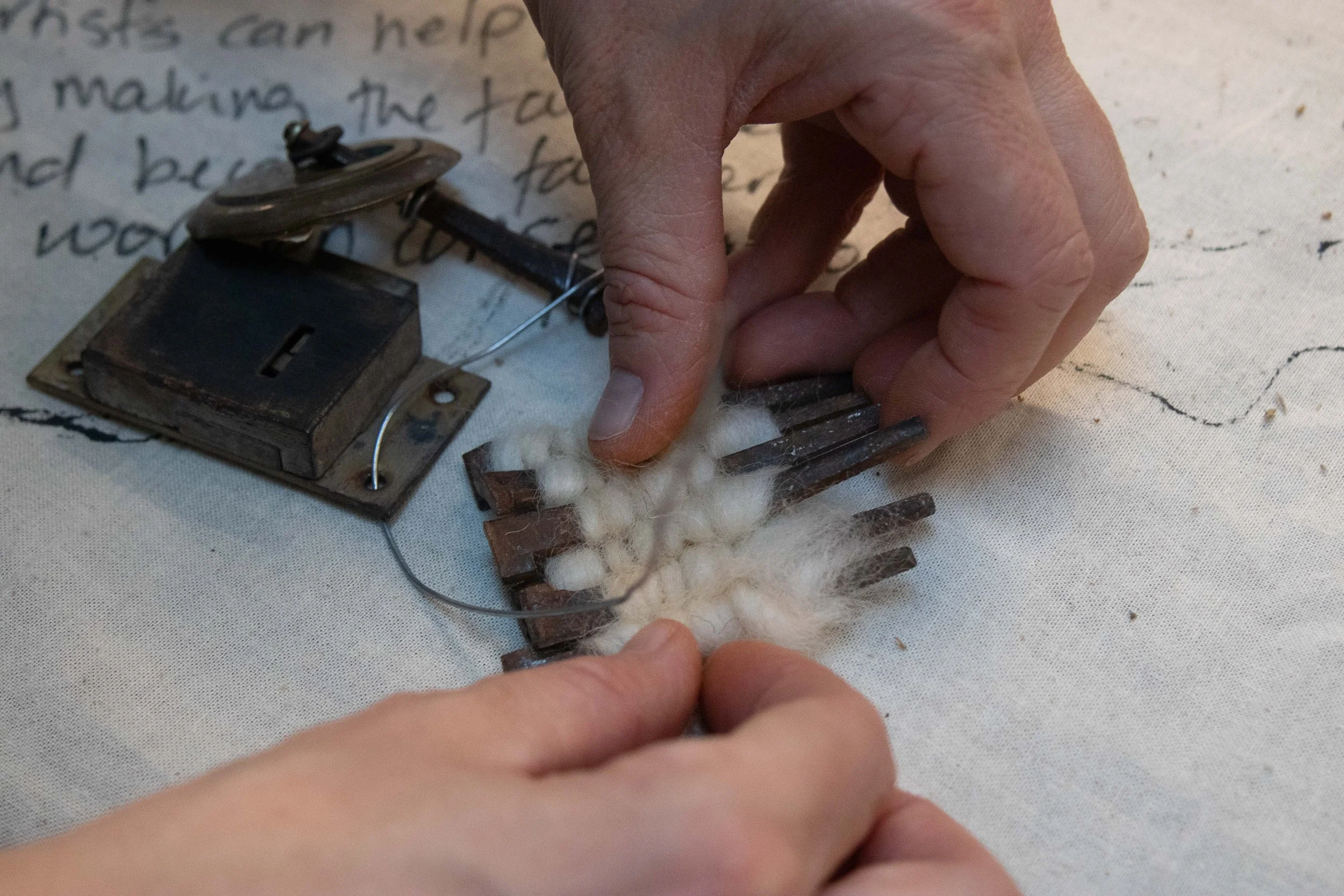
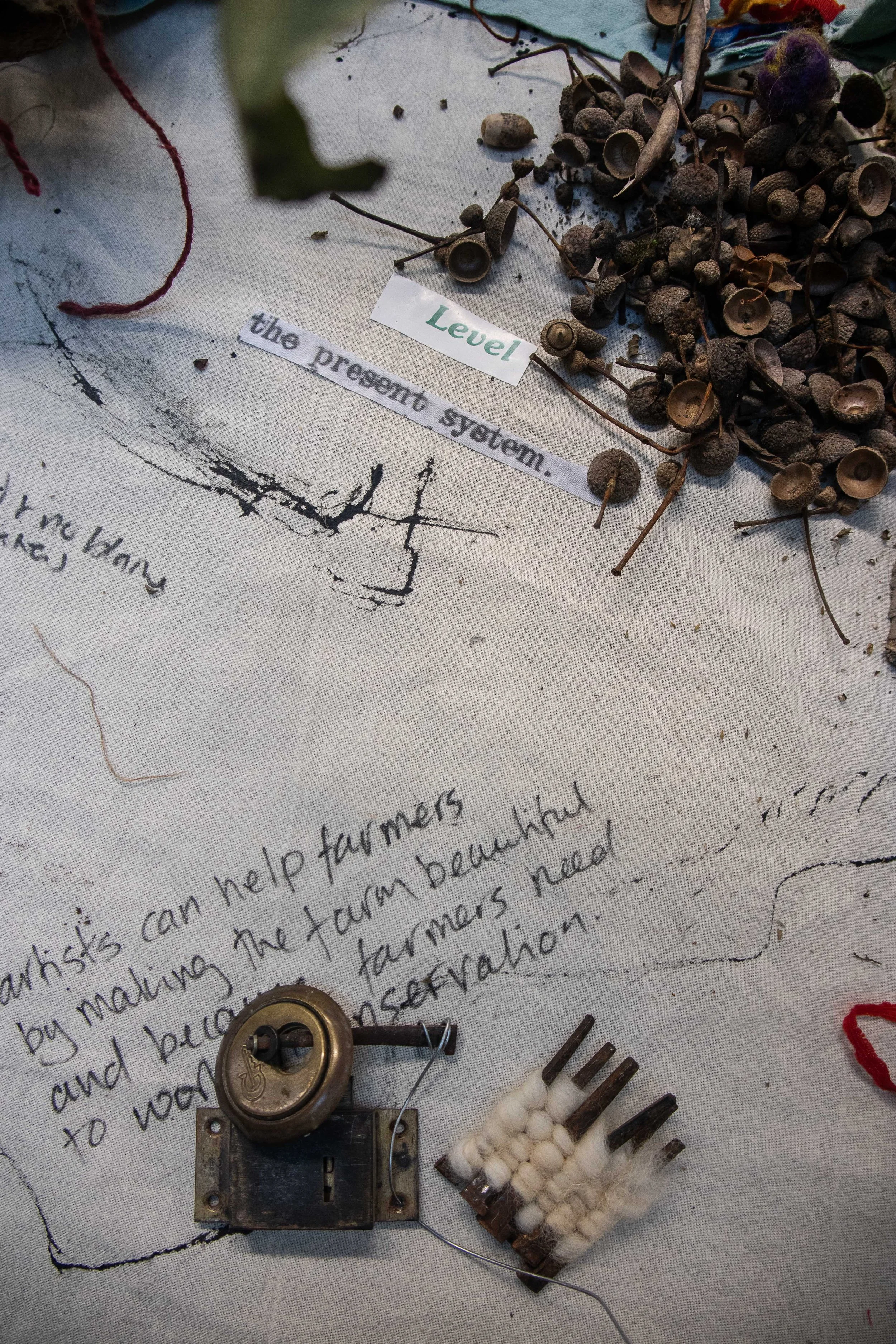
The words “beauty” and “beautiful” came up again and again at the kitchen table. For example, Sophie, a student of Pencoed College who was deeply engaged with the creative work, said that “artists can help farmers by making the farm beautiful”. Perhaps people spoke about beauty when asked how creative practitioners can work to support food and farming because, alongside our sense of connection, seeing and feeling things in the world as beautiful is a way in which we constitute our sense of meaning, belonging and value. And these in turn have burning relevance to whether and how we care about the world around us. In other words, attention to beauty can bring us very directly back to the way in which we go about doing the work that is ahead of us. A strange little “found words” poem on the tablecloth, seems almost to be a question, or perhaps it is a challenge:
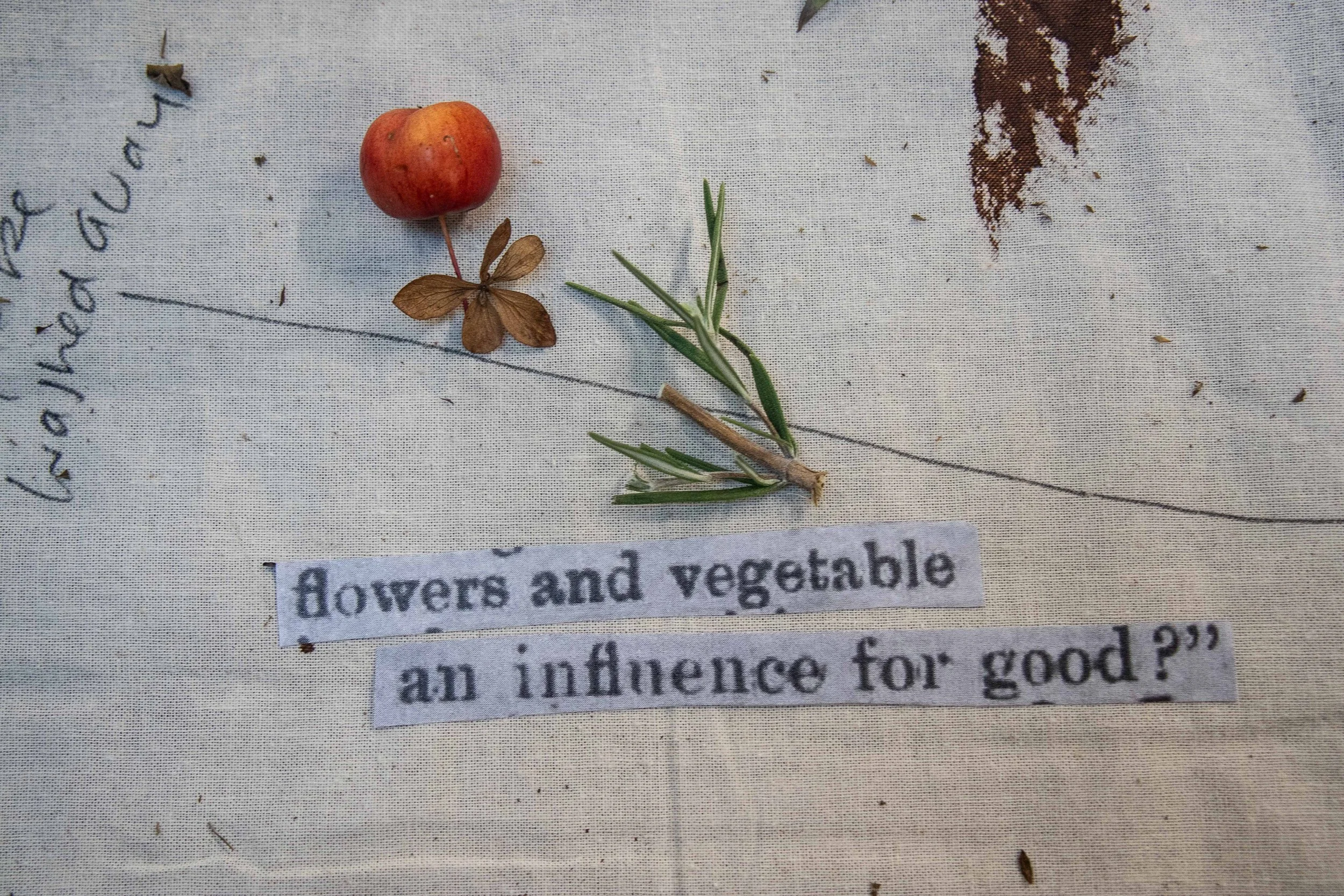
A conventional farmer
on behalf of
A
beautiful world
Creative work as a catalyst for positive change
“DISRUPT THE NORM
so that people have a space
so they have permission
to do something different
even if just for a minute
→ or think
in a
different
way
→ time as
just a belief
- people worry
too much
- they feel limited
by it
→ even just an hour a week
can make a difference”
Creative practitioners may approach their work in ways that seem odd to workers in other fields. For example, they may begin work by going for a walk, having a nap, sweeping a floor, or staring into space. This sounds nice, but it can be difficult to do - it goes against the norm. It comes about, I think, because of the rule for creative work: it is not a question of “doing the work” by following set steps to solve a particular problem, but of finding ways to set up the conditions for free play. When the person has got themselves out of the way, creative work may happen - by itself. Creative work then, may not appear according to clock-time, and we may not be able to make sense of it in terms of machine-like causes and effects. This kind of way of working can be unsettling, and it opens us up to disruption, breaking open given categories or ways of seeing, which may not feel good. But it is not clear that truly creative work can happen if we are thinking of the work as a means to an end or as a solution to a problem. And strangely, what emerges from creative work may actually solve problems.
Imagination: “→ different ways of thinking & imagining”
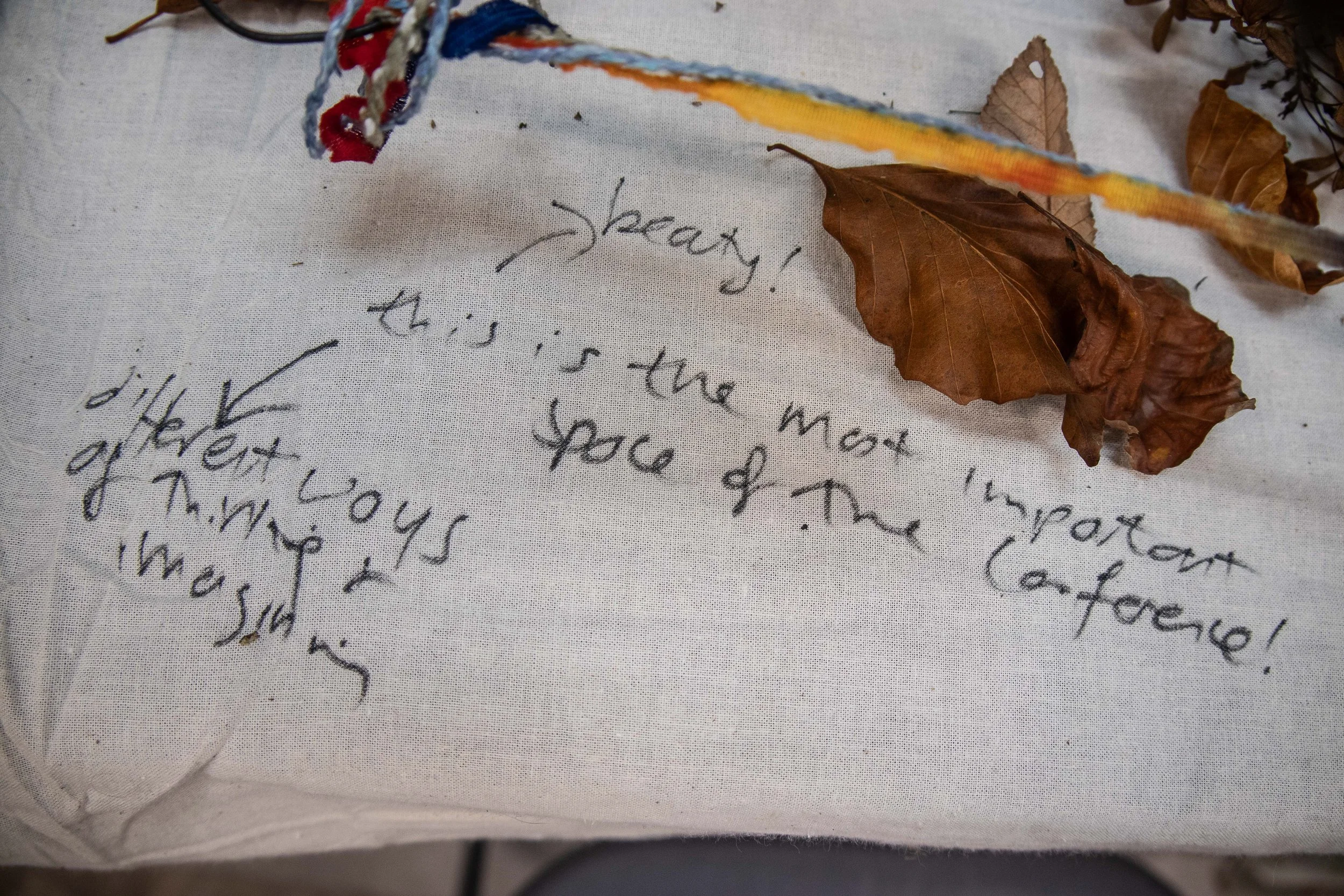
“support the
farm team to
dream up / imagine
how the farm could
be”
I have heard it said that we do not have imagination, rather, it is imagination that has us. I find it to be an interesting and imaginative idea.
Let us imagine then that through creative work we can practice, and get better at, letting ourselves be possessed by imagination. Perhaps we are practising inviting imagination into our room. Or perhaps we are practising leaving the room to explore the places where imagination lives. Here are some of the comments that were written on the tablecloth about imagination. They give an indication of what may be at stake in us taking up this practice: “art and spaces like this are critical → our future will be built / inherited through our imaginations”, and “without imagination we have no future”.
In creative work, we can make spaces where differences are valued, and where contributors with alternative approaches can flourish”
Someone wrote this comment, on creative work and diversity: “valuing and bringing in other ways of knowing”.

Over the course of the conference, the participants who were most consistently engaged with the creative work at “The Kitchen Table” were students of Pencoed College. Some were, for various reasons, finding it challenging to access the more formal sessions of the conference (such as talks, workshops or panels). Their contributions to the creative installation, meanwhile, were profound.
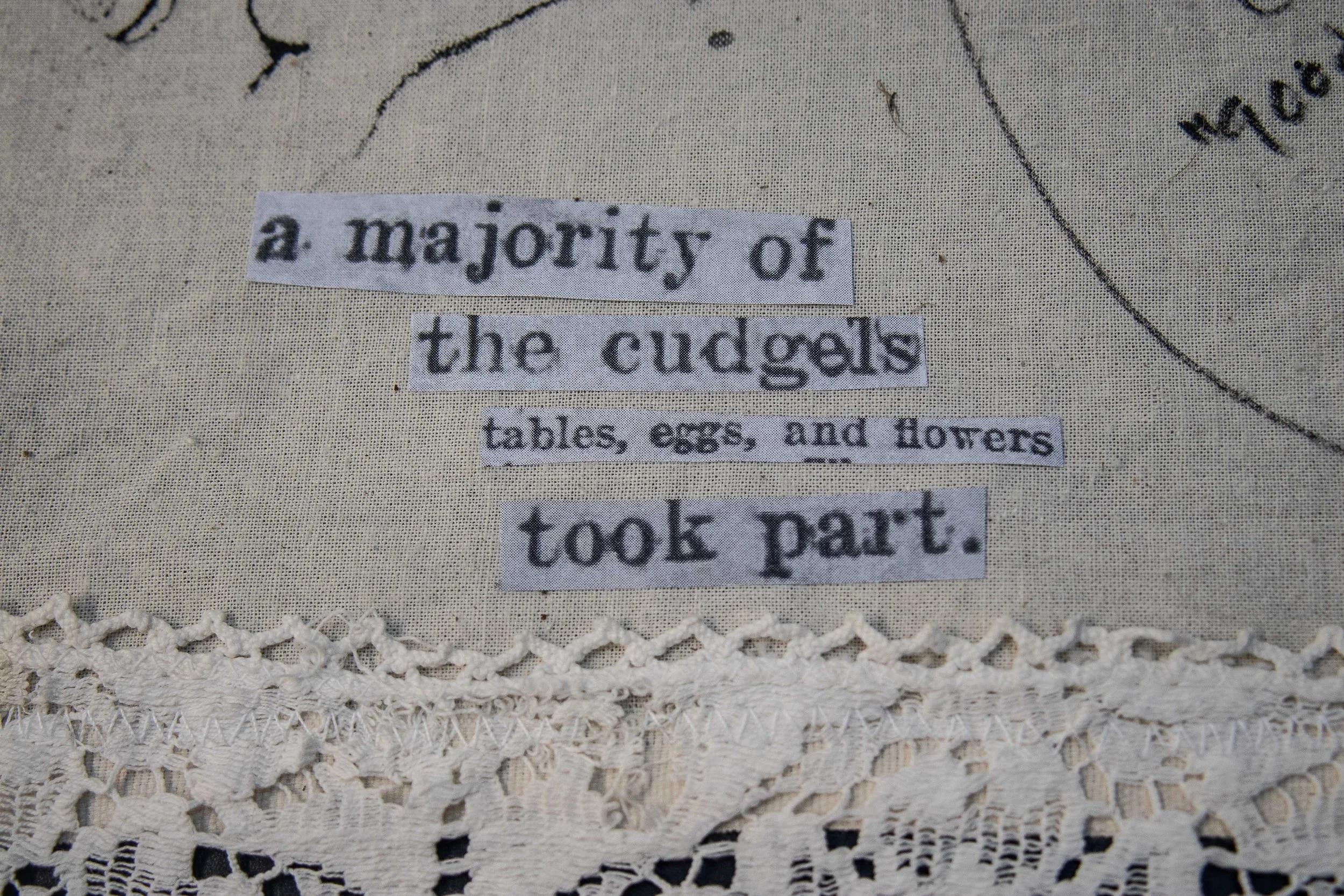
And we find, on the tablecloth another strange little poem, summing up the experience, and drawing to our attention the constant quiet accompaniment of the “more-than-human” conference participants:
a majority of
the cudgels
tables, eggs, and flowers
took part.
And finally, celebration! Praise-making, gratitude and attention to what is unfolding
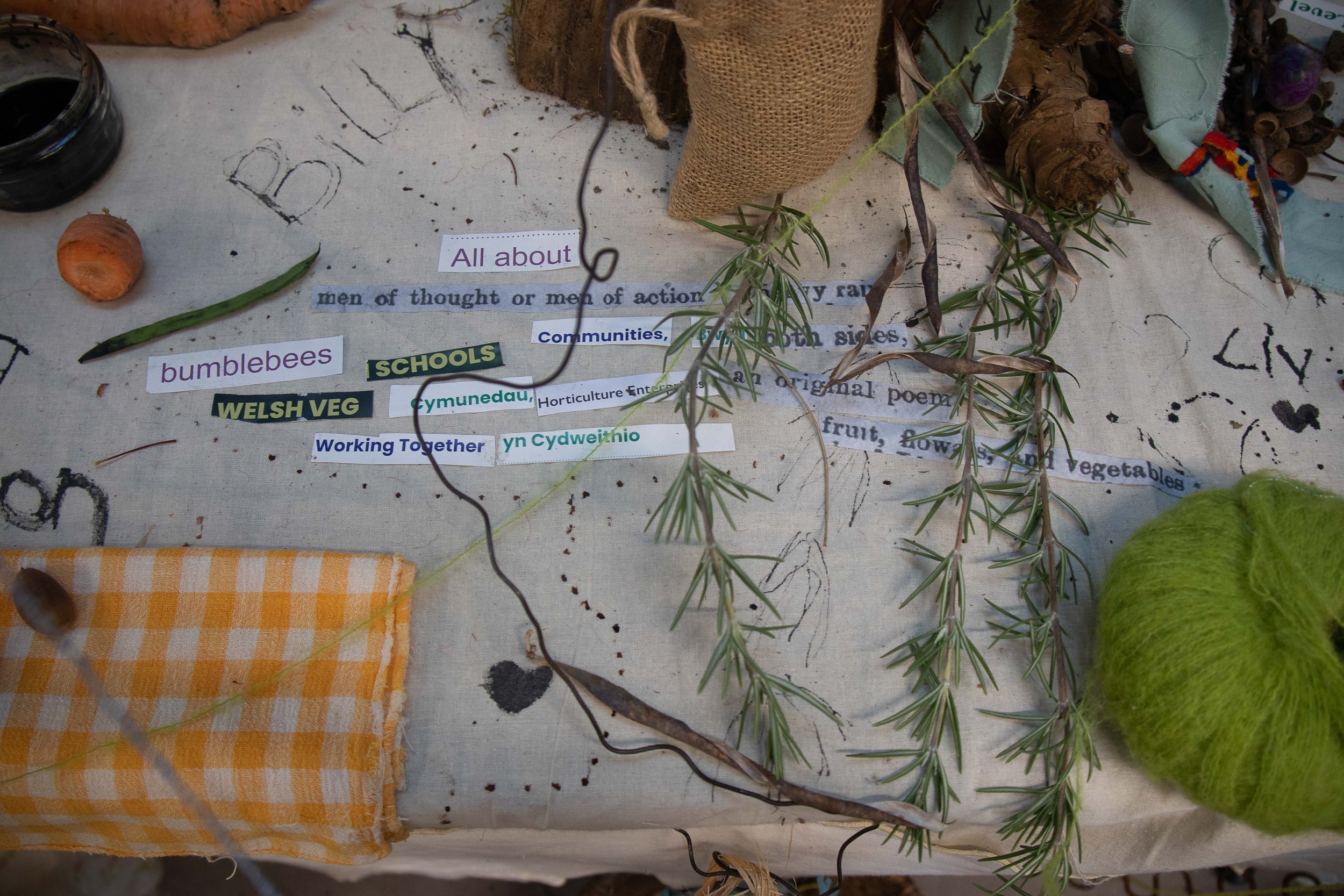
All about
women
men of thought or men of action
heavy rain
bumblebees
chickens
communities
bwyd
both sides
Soil
SCHOOLS
Earthworms
busnes gwledig
WELSH VEG
cymunedau
horticulture enterprises
an original poem
fruit, flowers, and vegetables
Working Together
yn Cydweithio
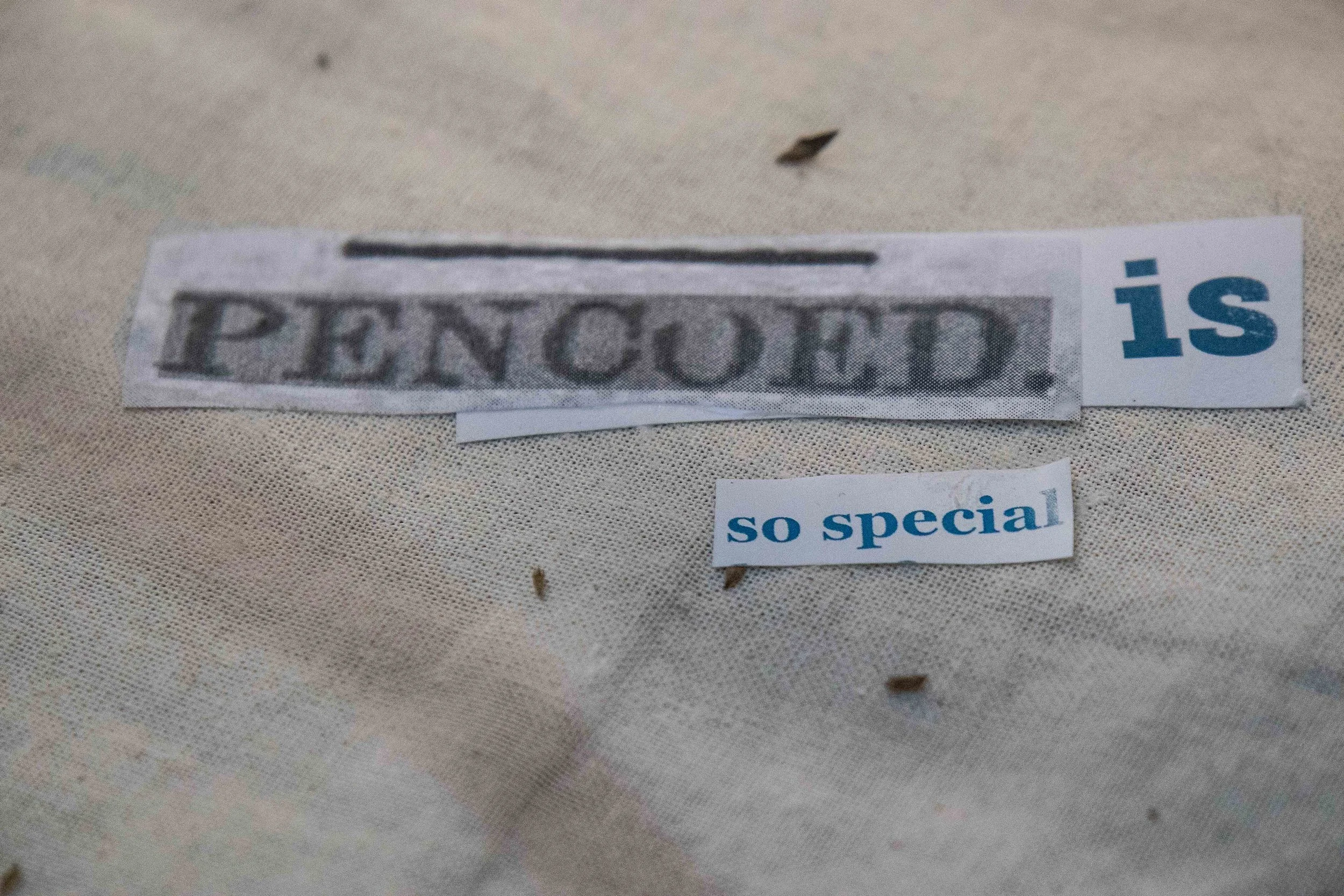
thank you
soil